
Field ExperimentNovember 202612 min read
ChatGPT vs. Data-Backed Career Tests in 2026: Five Real Profiles Tested Side by Side
We ran five real career profiles through ChatGPT and a 3,119-occupation labor engine. ChatGPT gave zero 2035 decline warnings, recommended three shrinking clerical jobs to a returning parent, and suggested a $29,530 pay cut as a nurse's top pivot.

Using ChatGPT as a career test feels fast and sensible until you check its answers against labor-market projections. In November 2026, we ran five real career profiles through a live ChatGPT web session and CareerPine's 3,119-occupation labor engine using identical constraints. ChatGPT cited current U.S. median salaries accurately on several common roles, yet gave zero 10-year decline warnings across all five profiles. Two of its five top picks are projected to shrink through 2035, all three suggestions for a returning parent were contracting clerical jobs, and its top recommendation for a clinical nurse carried a $29,530 annual pay cut.
The difference is structural. A chatbot maps your wording to familiar job titles, which works inside a healthy ladder like restaurant management, yet breaks silently when the obvious title sits in a shrinking field, pays far below your baseline, or carries high AI task overlap.
| Profile | ChatGPT #1 pick (pay) | BLS 2035 outlook | Data-filtered match (pay) | Filtered outlook |
|---|---|---|---|---|
| 1. 16yo student (drawing & games) | Graphic Designer ($62,960) | -1.7% | Web & Digital Interface / Performance Video Designer ($98,090 to $104,000) | +6.0% |
| 2. Line chef (5–9 yrs) | Food Service Manager ($69,390) | +5.8% | Restaurant Manager / Head Chef ($69,390) | +5.8% |
| 3. Clinical nurse (5–9 yrs, BSN) | Health Informatics Specialist ($68,020) | +15.9% (-$29,530 vs. RN) | Medical & Health Services / Medical Records Manager ($120,230 to $123,860) | +24.2% to +34.6% |
| 4. Returning parent (5-yr gap) | Administrative Assistant ($48,310) | -6.0% | Facilities Manager ($106,660) via Membership Admin ($49,500) | +4.6% (+0.8% entry) |
| 5. Senior manager (age 50) | Training & Dev Specialist ($69,280) | +10.8% | Business Coach / Management Coaching ($69,280) | +10.1% to +10.8% |
How we designed the five-profile benchmark
Most critiques of AI career advice feed a chatbot a vague one-liner. To test whether ChatGPT is genuinely accurate for career advice, we ran a live guest-mode English session with five structured profiles in one local market (Houston, Texas, stay-local), each specifying career stage, experience, education, short prep time, and skills.
We ran those same five inputs through CareerPine's scoring engine, which maps 3,119 occupations (3,039 from ESCO v1.2.1 plus 80 frontier digital roles) against O*NET 31.0 skill profiles, U.S. Bureau of Labor Statistics 2025–2035 Employment Projections, May 2025 wages, and generative AI exposure scores from International Labour Organization Working Paper 140.
Both systems returned three roles per profile, and ChatGPT also named one "Best initial target" for each person. We scored every pick on four metrics: 10-year growth, wage realism against current baseline pay, AI exposure, and constraint fit.
Side-by-side results across five real career profiles
Across all five transcripts, ChatGPT used the exact same encouraging tone whether a recommended role was expanding at +15.9% or shrinking at -6.0%.
Profile 1: The 16-year-old student who loves drawing and games
This Houston high schooler wanted visual design work, a small team, a stable salary, and a short initial ramp. ChatGPT suggested Graphic Designer ($62,960/year), Web and Digital Interface Designer ($98,090/year), and Special Effects Artist or Animator ($102,030/year), ranking Graphic Designer #1. Its tactical advice was practical: build a portfolio in Photoshop, Illustrator, Blender, or Figma, and check vocational certificates before paying for a four-year degree.
The miss was demand direction. Under BLS 2025–2035 projections, Graphic Designer employment is projected to shrink by -1.7%. ChatGPT's second pick, Web and Digital Interface Designer, grows +6.0% and pays $35,130 more at the national median ($98,090). Without a growth filter, ChatGPT steered a teenager toward the declining title first.
CareerPine elevated growing visual roles: Performance Video Designer (86% match, $104,000, +6.0% growth, 49% AI exposure), Production Designer (81% match, $114,850, +4.2% growth, 37% AI exposure), and Technical Writer / Knowledge Architect (81% match, $90,390, +0.8% growth). It also quarantined three shrinking creative-adjacent traps: Illustrator ($55,490, -2.9% growth, 49% AI exposure), Editor-in-Chief (-1.1% growth, 54% AI exposure), and Database Designer (-0.1% growth, 57% AI exposure).
Profile 2: The line chef aiming to run a restaurant or cafe
Our second profile was a Houston line chef with 5 to 9 years of kitchen experience and a vocational background aiming to manage a restaurant or open a cafe.
This was ChatGPT's clearest win. It recommended Executive Chef ($62,470/year), Food Service Manager ($69,390/year), and General and Operations Manager ($102,950/year), naming Food Service Manager the best first target. It also gave disciplined business advice: salaried management builds budgeting, food-cost control, scheduling, and vendor skills with far lower financial risk than opening a cafe immediately.
Both systems converged here. BLS projects Food Service Manager to grow +5.8% through 2035 at a $69,390 median wage. CareerPine's bridge-first top three were Restaurant Manager (95% match, $69,390, +5.8% growth, 36% AI exposure), Head Chef (95% match, $69,390, +5.8% growth, 25% AI exposure), and Pastry Chef (95% match, $37,160, +5.5% growth, 25% AI exposure). The labor engine added extra value by quantifying low AI exposure on floor leadership and flagging customer-facing desk traps like Receptionist ($38,630, -26.0% decline, 57% AI exposure) and Promotion Manager (-3.7% growth).
Profile 3: The clinical nurse moving into health tech and data
Our third profile was a Houston registered nurse with 5 to 9 years of experience and a bachelor's degree looking to shift into health data and clinical systems at a steadier pace.
ChatGPT suggested Health Informatics Specialist ($68,020/year), Medical and Health Services Manager ($123,860/year), and Medical Records Specialist ($51,140/year), alongside useful technical prep (SQL, Excel, Power BI, and Epic).
Then it committed a costly pay-anchoring miss. ChatGPT named Health Informatics Specialist ($68,020, +15.9% growth) as the "Best initial target." Under May 2025 BLS data, Registered Nurses already earn a national median of $97,550 (+5.6% growth, 29% AI exposure). Accepting ChatGPT's #1 pick represents a $29,530 annual pay drop. Its third pick, Medical Records Specialist ($51,140), would cut median pay by $46,410 for a nondegree role. ChatGPT never flagged that gap, even with Medical and Health Services Manager ($123,860 median, +24.2% BLS growth) listed directly below.
CareerPine preserved the nurse's degree and clinical standing. Its #1 ready-now match was Medical Records Manager (95% match, $120,230 median, +34.6% growth, 52% AI exposure, remote-capable), paired with Picture Archiving and Communication Systems Administrator ($51,140, +7.8% growth) and AI Workflow Implementation Specialist (95% match, bridge-first, $116,580 median, +5.1% growth, 20% AI exposure). It flagged Database Developer (-0.1% growth, 57% AI exposure) and ICT Technician (-3.5% growth, 47% AI exposure) as contracting traps.
Profile 4: The parent returning after a five-year caregiving gap
Our fourth profile was a stay-at-home parent re-entering the Houston job market after five years of caregiving, holding 2 to 4 years of prior office experience and a high school or vocational credential.
Every single job ChatGPT recommended is projected to shrink through 2035:
- Administrative Assistant ($48,310/year, -6.0% projected decline)
- General Office Clerk ($45,010/year, -5.6% projected decline)
- Material Recording Clerk ($47,600/year, also in structural contraction)
ChatGPT selected Administrative Assistant as the top target and advised refreshing Microsoft Office, Excel, and calendar management. It gave zero warning that routine clerical employment is shrinking nationwide or that document filing and scheduling face heavy generative AI overlap.
CareerPine mapped a non-shrinking ladder instead. For immediate high-school-level entry, it surfaced Membership Administrator (88% match, ready-now, $49,500 median, +0.8% growth) and Business Service Manager (79% match, bridge-first, $69,500, +0.1% growth, 42% AI exposure, remote-capable). With credential bridging, it pointed toward Facilities Manager (75% match, $106,660 median, +4.6% growth, 42% AI exposure). It explicitly quarantined Back Office Specialist (-7.6% growth, 64% AI exposure), Credit Manager (-4.3% growth, 60% AI exposure), and Proofreader (-0.9% growth, 51% AI exposure).
Profile 5: The 50-year-old operations manager seeking a lighter pace
Our fifth profile was a 50-year-old senior operations manager with 10+ years of experience and a bachelor's degree seeking corporate training or coaching with lighter operational stress.
ChatGPT led with Training and Development Specialist ($69,280/year, +10.8% BLS growth), a strong match requiring no new degree. Its second pick, Training and Development Manager ($133,000/year), contradicted the lighter-workload constraint by handing a burned-out manager another department to run, a flaw ChatGPT only walked back in a closing caveat. Its third pick was Human Resources Specialist ($72,910/year).
CareerPine kept all three ready-now matches inside individual coaching and advising: Business Coach (90% match, $69,280 median, +10.8% growth, 41% AI exposure, Bachelor's degree), Academic Support Officer (84%, $64,330, +2.9% growth, 33% AI exposure), and Academic Advisor (84%, $64,330, +2.9% growth, 33% AI exposure), alongside the +10.1% management and coaching benchmark. Because this profile also listed writing skills, the engine flagged three shrinking writing traps: Proofreader (-0.9%, 51% AI), Linguist (-0.2%, 59% AI), and Editorial Assistant (-1.1%, 54% AI).
Where ChatGPT did well and where its architecture breaks down
A fair verdict separates conversational fluency from labor-market calibration. ChatGPT did three things well:
- Accurate national wage retrieval: On mainstream roles ($69,390 for Food Service Manager, $69,280 for Training and Development Specialist, $51,140 for Medical Records Specialist), it pulled May 2025 BLS medians accurately and noted they were national figures rather than Houston wages.
- Practical prep advice: Its software lists (Figma, Blender, SQL, Power BI, Epic) and business cautions (manage a restaurant before opening a cafe) were grounded and useful.
- Speed: It built five structured career briefs in 12 seconds, making it a fast sounding board once you know which fields are growing.
The failures come from what a language model cannot do alone: run a deterministic filter over an occupation table. Four blind spots repeated across our five profiles:
- Zero contraction screening. Across 15 total suggestions, ChatGPT issued 0 decline warnings. It ranked Graphic Designer (-1.7%) #1 for a teenager and handed a returning parent three shrinking clerical roles (-6.0%, -5.6%, and contracting material recording).
- Wage-anchor blindness. Because a chatbot matches surface keywords ("nurse" plus "health records" yields "Health Informatics Specialist"), it missed that $68,020 sits $29,530 below an RN's $97,550 median, even with a $123,860 management path listed right underneath.
- Prompt-confirmation bias. Describe yourself as an organized office worker and ChatGPT mirrors that phrase back as Administrative Assistant and General Office Clerk instead of crossing taxonomy boundaries into non-shrinking roles like Membership Administrator or Facilities Manager.
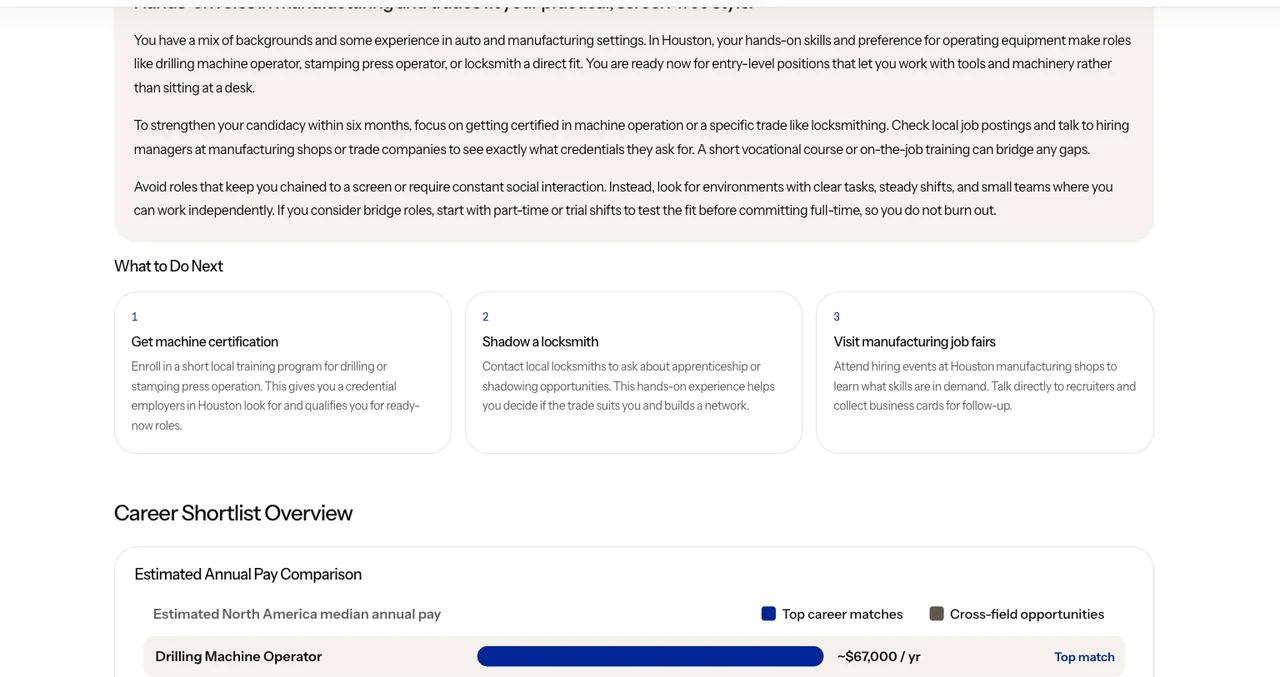
- No AI exposure scoring or trap quarantine. ChatGPT described a 25% AI-exposure kitchen leadership job and a 60%+ AI-exposure clerical job with identical optimism. A structured engine plots growth directly against automation risk and separates strong matches from traps, as shown in a sample CareerPine report. If you already have a chatbot shortlist, checking those titles in an AI job risk checker catches high-exposure clerical or writing traps before you pay for a course.
How to combine ChatGPT with labor-market data
You do not need to ban ChatGPT from your job search, nor should you let it pick your target role alone. Split the process into three steps:
- Filter the occupation map first. Start with an assessment scoring your skills, pay floor, and credential budget against verified 10-year growth and AI-exposure tables. Our guide to the best career test websites separates labor-backed platforms from personality quizzes, or you can take a baseline career personality test to clarify your work style before picking titles.
- Audit three numbers before paying for training. Verify each role's 2025–2035 BLS growth rate, its median wage against your current pay, and its ILO generative AI exposure score. Drop shrinking, high-exposure roles unless they serve as a brief stepping stone.
- Use ChatGPT for execution after selection. Once data narrows your shortlist to two or three growing targets (such as Medical Records Manager or Business Coach), ChatGPT works well for rewriting resume bullets, building a 30-day SQL or Epic study plan, and rehearsing interviews.
Frequently asked questions
- Is ChatGPT accurate for career advice in 2026?
- ChatGPT is accurate for brainstorming, skill checklists, and rough national wage lookups, yet unreliable as a standalone career test. In our five-profile test, it issued zero 2035 decline warnings, recommended three shrinking clerical roles to a returning parent, and put a $29,530 pay cut at the top of a nurse's shortlist.
- Why did ChatGPT recommend shrinking jobs to the returning parent?
- Language models match prompt words to statistically common job titles rather than querying a 10-year labor forecast. Because the profile mentioned organized office work after a five-year gap, ChatGPT defaulted to Administrative Assistant (-6.0% projected growth), General Office Clerk (-5.6%), and Material Recording Clerk without screening for clerical decline or AI exposure.
- Can better prompting fix ChatGPT's career recommendations?
- Better prompting helps if you explicitly tell ChatGPT to reject negative 2025–2035 BLS growth and any median wage below your current salary. Even then, without structured joins across 3,119 ESCO occupations and ILO exposure tables, it can miss cross-field bridges and conflate adjacent roles.
- When does ChatGPT actually match a data-backed career test?
- ChatGPT matches a labor engine when your move follows an obvious, growing ladder in a physical industry. In Profile 2, both ChatGPT and CareerPine steered a line chef into food service or restaurant management ($69,390 median, +5.8% projected growth), where hands-on operations keep AI exposure low.
- What should I check before acting on an AI-generated career shortlist?
- Check four numbers for every suggested title: its 2025–2035 BLS growth rate, its median wage versus your current pay, its required credential timeline, and its generative AI exposure score. Running those checks takes five minutes and prevents training for a contracting role.
See how these numbers apply to your own profile
Take the free 5–10 minute branching assessment or look up any of 3,119 occupations in the AI Job Risk index.
More notes
Field Benchmark18 min read
10 Best Career Test Websites in 2026: Tested Side by Side
Career Data Study13 min read
15 Common Jobs People Want to Leave and Their Highest-Paying Skill-Matched Pivots
Labor Market Study12 min read
Entry-Level Careers Surviving AI in 2026: Best Zero-Experience Roles Ranked by Growth and Pay
Global Mobility Index12 min read
The Cross-Border Career Portability Index (2026): Which Occupations Travel Abroad Without Re-Licensing